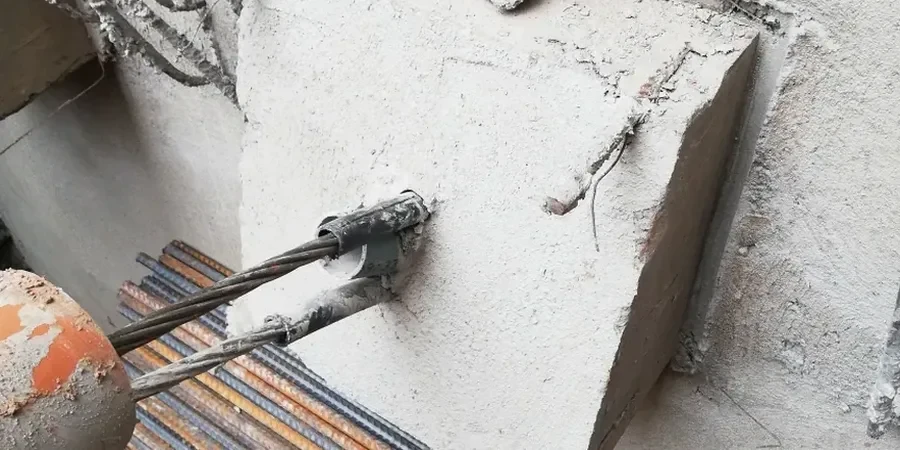
Tralee’s subsurface is defined by its complex glacial history, where stiff limestone-rich till overlies Carboniferous karst bedrock. The water table across the townlands near the River Lee often sits within 3 metres of the surface, creating persistent challenges for excavation support. An active/passive anchor design must reconcile these saturated overburden soils with the unpredictable dissolution features in the limestone beneath. Our technical team addresses this by specifying double corrosion protection and executing in-situ suitability testing, ensuring each anchor system delivers the required bond capacity without risking a sudden loss of grout into a hidden cavity. For projects near the protected architecture of Denny Street, we frequently integrate anchor designs with retaining wall analysis to limit lateral movement in sensitive urban environments.
A single well-designed active anchor in Tralee limestone can replace several passive strands, reducing installation time without compromising the factor of safety on the excavation face.
FAQ
How much does an anchor design and installation package cost in Tralee?
For projects in Tralee, the total cost for anchor design, suitability testing, and installation supervision typically ranges between €1,020 and €3,440. The final figure depends on the anchor type, the required capacity, and the number of verification tests needed to prove the bond in the local limestone.
What distinguishes an active anchor from a passive one in practice?
An active anchor is tensioned against the structure immediately after grouting, applying a pre-determined force to prevent ground movement from the start. A passive anchor is not tensioned; it only develops resistance in response to ground displacement. We select the active option for deep excavations adjacent to Tralee’s historic buildings, while passive anchors are more common for temporary works and rock slope reinforcement.
How do you verify that an anchor will perform as designed?
We follow the three-tier testing regime set out in I.S. EN 1537. An investigation test on sacrificial anchors establishes the ultimate bond strength of the Tralee ground. A suitability test on working anchors confirms the design assumptions at 1.3 times the service load. Finally, every production anchor undergoes an acceptance test at 1.25 times the service load, with load-extension graphs recorded to detect anomalies in the bond zone.