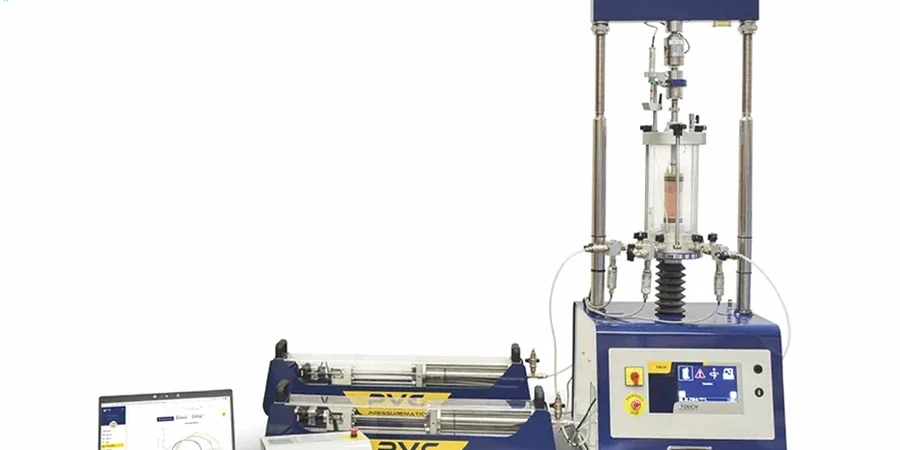
Tralee’s development from a medieval port town into a modern county capital has placed increasing structural demands on its complex subsurface. The town centre rests on alluvial deposits along the River Lee’s floodplain, while the surrounding drumlin landscape introduces compact glacial till with high stone content. Every deep excavation and foundation in these contrasting materials requires precise shear strength data, and that is where the triaxial test becomes essential. In a consolidated-undrained setup with pore pressure measurement, our laboratory determines the effective stress parameters that govern long-term stability. We run multi-stage tests on undisturbed Shelby tube samples recovered from boreholes across Tralee, and for projects near the canal basin—where soft silts extend to significant depth—we complement the triaxial programme with in-situ permeability profiling to evaluate drainage conditions during shearing. The test simulates field confining pressures matching the overburden stress at the sampling depth, yielding a Mohr-Coulomb envelope that feeds directly into bearing capacity and slope stability calculations. For critical infrastructure schemes, we also correlate triaxial stiffness degradation curves with MASW shear wave velocity profiles to refine the seismic site response model in accordance with the Irish National Annex to Eurocode 8.
Regional considerations
The most frequent mistake we see in Tralee's construction sector is relying on quick undrained triaxial data without measuring pore pressure, then applying those total stress parameters to a long-term drained analysis. A basement excavation in the alluvial silts along the River Lee, for instance, may stand up perfectly during the short construction window—but six months later, as the negative pore pressures from unloading dissipate, the effective stress drops and the factor of safety can fall below 1.0. The only way to predict this is with a CU+PP triaxial test that tracks the stress path. Another common error is testing remoulded specimens from cable percussion boreholes and assuming they represent the intact strength of the glacial till. The till in Tralee's drumlin formations has a fabric and stone content that remoulding destroys completely, yielding friction angles 3 to 5 degrees lower than the in-situ material—enough to trigger a slope failure in an unsupported cut.
FAQ
What is the cost of a triaxial test programme in Tralee?
A full triaxial programme—typically three specimens from the same sample depth tested at different confining pressures—ranges from €1.650 to €2.150. The final figure depends on whether consolidated-undrained, unconsolidated-undrained, or drained conditions are required, and on the number of depths to be characterised. The price includes specimen preparation, saturation, consolidation, shearing, and the Mohr-Coulomb parameter report. Projects needing multi-stage tests on a single specimen to reduce sample quantity are also within this range, though they require additional interpretation time.
Which triaxial test type is most suitable for Tralee's glacial till?
For Tralee's compact glacial till, the consolidated-undrained triaxial test with pore pressure measurement (CU+PP) is the recommended approach. The till's low permeability means drainage during construction is negligible, so undrained strength governs short-term stability. Measuring pore pressure during shearing allows us to separate total and effective stress paths, giving both short-term and long-term design parameters from a single test stage. Specimens must be carefully trimmed to avoid disturbing the stone-matrix contact, which is common in drumlin-derived tills across County Kerry.
How long does a triaxial test programme take from sample arrival to report?
A standard three-specimen triaxial programme requires approximately 10 to 14 working days. The consolidation phase alone can take 24 to 48 hours per specimen depending on the soil's permeability, and shearing at the prescribed strain rate may extend over several hours. We schedule saturation and consolidation in parallel across multiple triaxial cells to optimise turnaround. If a project requires an interim verbal update on key parameters ahead of the formal report, we can carry out that within five working days of sample receipt.
What sample quality is needed for a reliable triaxial test?
The triaxial test demands high-quality undisturbed samples, ideally obtained with a thin-walled Shelby tube or a hydraulic piston sampler. Samples should be sealed immediately on site with wax or end caps, transported vertically, and stored at constant humidity. Disturbed or remoulded samples cannot yield valid effective stress parameters. We assess sample quality upon arrival using the Andresen criterion, and specimens showing significant disturbance are flagged so the design team can apply appropriate correction factors or consider re-sampling.
Do you provide the stress-strain and pore pressure curves with the report?
Yes, every triaxial test report includes the complete set of curves: deviator stress versus axial strain, pore pressure change versus axial strain, the effective stress path on a Cambridge p'-q diagram, and the Mohr-Coulomb failure envelope with the derived effective cohesion and friction angle. We also report the secant Young's modulus at 50 percent of the failure stress (E50) for deformation analysis. All data is supplied in PDF and spreadsheet format for direct input into finite element or limit equilibrium models.