← Home · Investigation

Exploratory Test Pits in Tralee — Ground Truth Before You Break Ground

Together, we solve the challenges of tomorrow.

LEARN MORE →

Tralee’s urban footprint expanded from its medieval core along the River Lee into the reclaimed marshlands of the Big and Small Monsters—shifting from dry limestone ridges to soft alluvial deposits in under a kilometre. That patchwork geology makes the exploratory test pit one of the most straightforward tools available for anyone building an extension, a commercial unit, or a multi-unit scheme around the town. A machine-excavated trench lets the engineering team walk up to the profile, log the strata with their own eyes, and take undisturbed samples right where the load will sit. We open these pits from Ballymullen to Mounthawk, SPT drilling adding depth when the pit can’t reach refusal, and trial pits in clay giving the same visual confidence on smaller residential lots. In a town where ground conditions shift street by street, side-stepping a physical inspection is the fastest route to an expensive surprise.

One open trench tells you more about Tralee’s subsoil than a dozen indirect tests—seeing is engineering.

Our approach and scope

The Atlantic weather that sweeps across Tralee Bay dictates more than jacket choice—it controls when a trench stays stable and when the sides start slumping. Winter groundwater sits high in the low-lying estates off Dan Spring Road, so a springtime excavation often reveals a different water table than an August dig. We schedule pits around the Kerry rainfall pattern and log the moisture profile while the face is fresh. Each pit is benched to IS EN 1997-2 requirements and backfilled in lifts with documented compaction where future footings are planned. The log sheet captures layer depth, consistency, colour, and any organic lenses that could compress under load. When the soil transitions from sandy gravel into a soft silt pocket, we often pair the observation with a grain-size analysis to confirm the fraction that controls drainage. That kind of detail stops a foundation design from guessing about what is really underneath.
Exploratory Test Pits in Tralee — Ground Truth Before You Break Ground
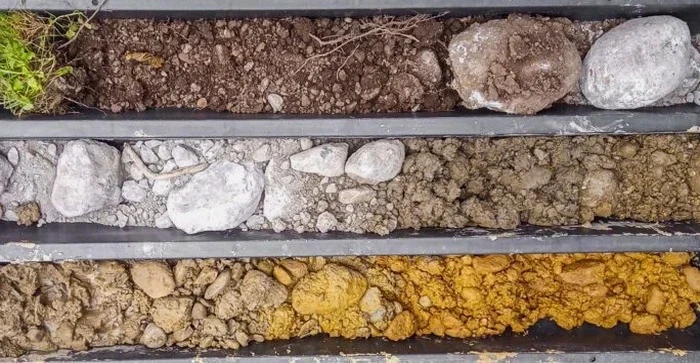
Technical reference image — Tralee

Local considerations

Ireland’s National Annex to Eurocode 7 (IS EN 1997-2:2007) requires direct investigation of the bearing stratum wherever the consequence class is CC2 or higher. Tralee brings a specific challenge: the estuarine silts that underlie the southern approach to the town centre are notoriously variable, and a borehole located five metres from a trench can miss a buried peat lens that a pit exposes immediately. Skipping the visual inspection puts the designer in the position of assuming homogeneity across a site that was literally underwater two centuries ago. If a contractor pours a strip footing on what looks like competent gravel but is actually a thin skin over soft silt, the differential settlement shows up fast. The cost of a test pit vanishes against the cost of underpinning later. Our lab operates under an ISO 17025-accredited management system, so the logs carry the weight needed for the Assigned Certifier’s file.

Need a geotechnical assessment?

Reply within 24h.

Email: contact@geotechnical-engineering.co

Technical data

ParameterTypical value
Maximum depth (standard excavator)4.0–4.5 m below ground level
Trench width600–900 mm (stable ground)
Sampling methodBlock samples / Shelby tubes from bench
Backfill standardLayered compaction ≥ 95% MDD (Proctor reference)
Groundwater observationLogged at time of excavation + 24 h standpipe
Safety complianceS.I. No. 504/2006 (Confined Spaces) + CAT scan prior
Reporting turnaroundDraft log within 48 h, final report 5 working days

Related services

01

Machine-Excavated Trial Pits

Tracked excavator opening trenches to 4.5 m, logged by a geotechnical engineer with full photographic record and chain-of-custody sampling.

02

Hand-Dug Inspection Pits

Shallow pits inside existing buildings or tight-access yards, compliant with confined-space regulations, used for underpinning assessments.

03

In-Situ Density Testing

Sand-cone or nuclear gauge density checks on backfill lifts, verifying compaction meets the specification before slab construction.

04

Soil Laboratory Suite

Classification, shear-box, and consolidation testing on samples taken directly from the pit face, all under ISO 17025 quality control.

Relevant standards

IS EN 1997-2:2007 (Eurocode 7 – Ground investigation and testing), S.I. No. 504/2006 (Safety, Health and Welfare at Work – Confined Spaces), IS EN ISO 14688-1:2018 (Identification and classification of soil), IS EN ISO 17892 series (Laboratory testing of soil)

Frequently asked questions

How much does an exploratory test pit cost in the Tralee area?

For a standard machine-excavated pit with engineer logging, sampling, and a factual report, the range in Tralee typically runs from €460 to €650. The final figure moves with depth, access constraints, traffic management, and the number of samples sent to the lab. A site with two or three pits usually brings the per-unit cost down.

Do I need a test pit if I already have borehole data on my Tralee site?

Boreholes give you a vertical column; a test pit gives you a continuous horizontal face. In Tralee, where fluvial and estuarine deposits can pinch out over short distances, the pit reveals lateral changes that a borehole can easily miss. Most designers request at least one pit to ground-truth the borehole interpretation, especially near the river corridor.

What safety precautions apply to deeper excavations?

Any excavation deeper than 1.25 m triggers the requirements of S.I. No. 504/2006. We bench or batter the sides, deploy a trench box where needed, run a CAT scan for buried services before the bucket goes in, and keep the spoil at least one metre from the edge. An engineer stays at surface level unless the pit is fully supported and gas-monitored.
Location and service area

We serve projects in Tralee and surrounding areas.

View larger map