← Home · Slopes & Walls

Retaining Wall Design in Tralee: Geotechnical Engineering for Demanding Sites

Together, we solve the challenges of tomorrow.

LEARN MORE →

Tralee sits just 7 meters above sea level at its lowest point, on the floodplain where the River Lee meets the tidal estuary. That low elevation means groundwater is never far from the surface, and the alluvial silts and soft clays beneath the town centre demand careful retaining wall design. We have worked on projects from the canal-side to the edges of the Slieve Mish foothills, and the ground profile changes fast. A wall that holds perfectly in gravelly till might need a complete rethink 200 metres away in estuarine deposits. The design has to match the ground, not the other way around. We combine local borehole data with advanced limit equilibrium analysis to size stems, heels, and toes for the long term. When the site investigation flags pockets of organic silt, we often specify a CPT test to map the soft layer continuously before fixing the foundation level, because missing a lens of that material under a cantilever wall is a costly mistake.

In Tralee’s soft alluvium, a retaining wall’s first job is controlling water—structural design comes second.

Our approach and scope

The bedrock beneath Tralee is part of the Namurian shale and sandstone sequence that underlies much of north Kerry, but the overburden is what governs most failures. Glacial tills on the higher ground are dense and overconsolidated, offering good bearing, yet the lower town is draped in soft, normally consolidated silty clay that can lose strength when saturated. A retaining wall in Tralee has to handle two distinct groundwater regimes: a perched table in the upper gravels after heavy Atlantic rain, and a deeper tidal-influenced table near the quays. We design drainage systems behind the stem that can cope with both. For walls exceeding 3 metres, we often integrate a deep excavation monitoring plan right from the concept stage, because temporary works stability during the dig can dictate the permanent design. The geological variety means we never assume a single soil profile; every wall is checked against at least two credible ground models.
Retaining Wall Design in Tralee: Geotechnical Engineering for Demanding Sites
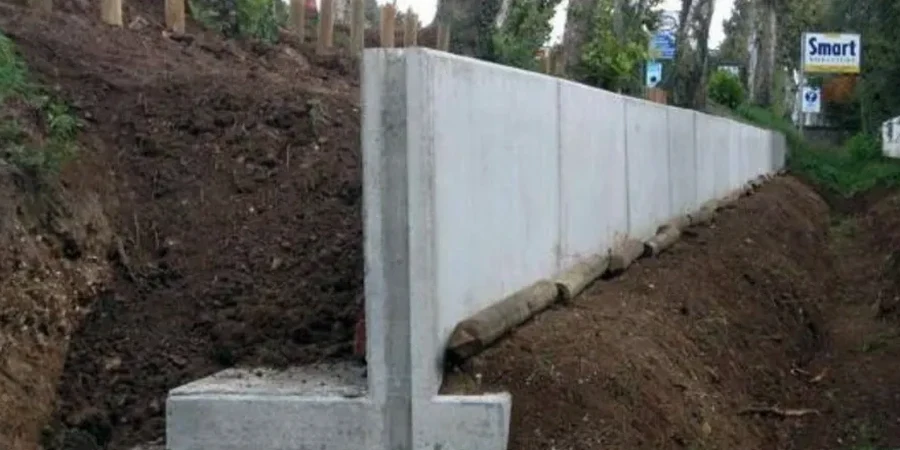
Technical reference image — Tralee

Local considerations

We reviewed a three-storey apartment scheme off the Dan Spring Road where the contractor had already dug a 4-metre cut into the slope and the face was starting to ravel after a week of Kerry drizzle. The original design assumed a simple cantilever wall founded in stiff till, but the excavation exposed a band of laminated silt that had been missed by the preliminary boreholes. Overturning and bearing checks had to be re-run overnight. We added a shear key and moved the drainage blanket to a steeper inclination to intercept water migrating along the silt lenses. The wall was built, and six years later it has not moved a millimetre. That job reinforced a basic rule: in Tralee’s mixed glacial and alluvial ground, you never finalise the retaining wall design until you have seen the full excavation face and verified the stratigraphy with your own eyes.

Need a geotechnical assessment?

Reply within 24h.

Email: contact@geotechnical-engineering.co

Technical data

ParameterTypical value
Design standardEurocode 7 (I.S. EN 1997-1:2004), Irish National Annex I.S. EN 1997-1/NA:2005
Typical wall types analysedCantilever RC, gravity mass concrete, embedded sheet pile, king post, gabion
Ground model resolutionCPT/SPT at max 20 m centres, supplemented by trial pits in critical zones
Groundwater considerationSteady-state and drawdown flow nets; tidal lag analysis near estuary
Backfill specificationTII Series 600 or project-specific free-draining granular fill with geotextile wrap
Seismic check (low seismicity)I.S. EN 1998-5 Annex E pseudo-static check where required by Client
Factor of safety (STR/GEO)DA1 Combination 1 and 2; minimum FoS ≥ 1.0 on design resistance

Related services

01

Cantilever & Gravity Wall Design

Full structural and geotechnical design of reinforced concrete cantilever walls, mass concrete gravity walls, and gabion walls up to 6 metres retained height. We handle the complete ULS and SLS verification in accordance with I.S. EN 1997-1, including global stability checks on sloping sites like those found on the Tralee-Fenit road.

02

Embedded & Sheet Pile Wall Analysis

Design of steel sheet pile and king post walls for basement excavations and quay structures near the Tralee Ship Canal. We model the passive resistance in soft alluvium and check for piping and hydraulic heave where tidal water levels fluctuate daily.

03

Construction-Stage Support & Temporary Works

On-site review of excavation faces, approval of backfill materials, and verification that the built wall matches the design assumptions. We provide rapid response when unexpected ground is encountered, helping contractors keep the programme on track without compromising safety.

Relevant standards

I.S. EN 1997-1:2004 + Irish National Annex (Eurocode 7: Geotechnical design), I.S. EN 1992-1-1:2004 + NA (Eurocode 2: Design of concrete structures), I.S. EN 1998-5:2004 + NA (Eurocode 8: Seismic design, Annex E), TII Publications (formerly NRA) Series 600 – Earthworks and retaining structures

Frequently asked questions

What is the typical cost for retaining wall design in Tralee?

For a residential or small commercial retaining wall in Tralee, our design fees generally fall between €840 and €3,290, depending on wall height, ground complexity, and the number of design checks required. A simple cantilever wall under 1.5 metres on competent till sits at the lower end; an embedded sheet pile wall in soft alluvium with tidal groundwater and global slope stability analysis moves toward the upper range.

How long does it take to design a retaining wall in Tralee?

A straightforward cantilever wall design with existing ground investigation data can be completed in two to three weeks. More complex walls needing additional CPT testing, tidal analysis, or negotiation with adjacent landowners may take four to six weeks. We always align our programme with the contractor’s start date to avoid holding up the dig.

Do you design both temporary and permanent retaining walls?

Yes, we design both. Temporary works, such as trench supports and basement shoring, are designed to the same safety standards as permanent walls but with a defined service life. We specify corrosion allowances for steel elements and check for the rapid groundwater changes that can occur during Tralee’s wet winters.

What ground investigation is needed before you can start design?

At a minimum, we need boreholes or CPT soundings to at least twice the retained height below the proposed founding level, plus laboratory classification and strength testing on undisturbed samples. In Tralee’s soft alluvial areas, we strongly recommend piezometers to establish the groundwater profile over at least one tidal cycle before finalising the earth pressure calculations.
Location and service area

We serve projects in Tralee and surrounding areas.

View larger map