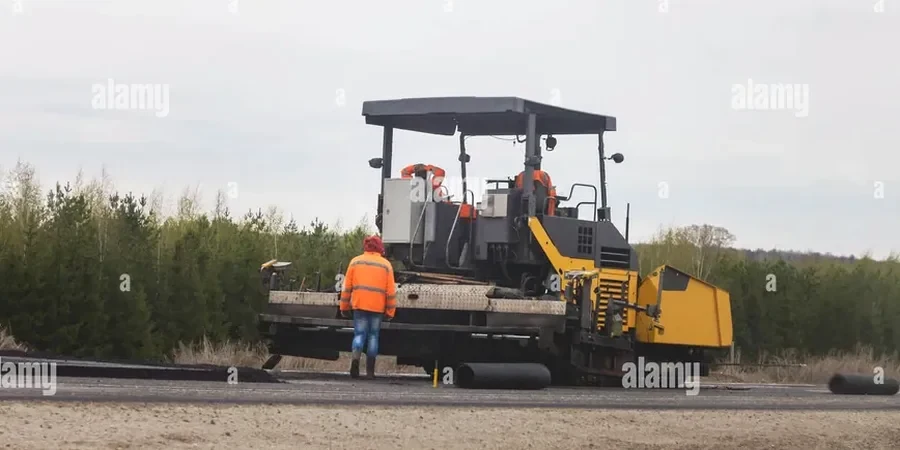
Tralee sits on a complex mix of glacial till, alluvial deposits, and occasional peat pockets left by the River Lee's historic floodplain. With over 23,000 people relying on road infrastructure that handles Kerry's year-round rainfall, pavement layers work hard here. We design flexible pavements that account for the town's soft subgrades and high water tables, common from Ballymullen to the Dingle Road approach. Instead of copying generic cross-sections, our team runs CBR tests on actual site material, evaluates drainage conditions, and builds layer thicknesses that match real traffic loads. For projects near the Rose of Tralee festival grounds or new housing off the Castlemaine Road, a pavement failure within two years is not acceptable. Combining local geotechnical data with the CBR test for road design gives us the numbers to justify every millimetre of asphalt and granular fill. We've seen too many cracked car parks in Tralee that started with a desk study and ended with a costly dig-out.
A pavement is only as strong as the subgrade it rests on. In Tralee, that means testing before designing, every single time.
Our approach and scope
Ireland's TII Publication DN-PAV-03023 and the older NRA HD 26/11 define the framework, but Tralee's specific geology demands more than a standard catalogue selection. The underlying Namurian shales and sandstones weather into a silty clay that loses strength fast when saturated. We run soaked CBR tests at multiple depths because the top 300 mm often misleads during a dry week in June. Our pavement designs for Tralee projects typically include a capping layer where CBR drops below 5%, followed by a granular sub-base meeting NRA Clause 804 gradings. For commercial yards handling HGV traffic off the N21, we model equivalent standard axles over a 20-year design life rather than guessing. Permeability checks on the formation layer prevent the classic Kerry failure: trapped water softening the subgrade under wheel ruts. Each design memorandum includes layer thicknesses, material specifications, and a drainage strategy tied to the site's actual infiltration capacity.
Regional considerations
A dry summer like 2018 can give a false sense of subgrade strength around Tralee. That silty clay may read CBR 8% in August and collapse to CBR 2% by November. Designing on seasonal assumptions leads to rutting, fatigue cracking, and edge failure within three winters. The contrast between the sandstone hills north of town and the flat ground near Blennerville means drainage patterns shift quickly across a single site. We've assessed car parks in Tralee where the asphalt failed not because of traffic, but because the formation sat saturated for months without an underdrain. A pavement design without a site-specific drainage plan is a liability. Our reports flag the groundwater condition, soil plasticity, and frost susceptibility before recommending a cross-section. For main-road projects linking Tralee to Killarney, we also evaluate the risk of differential settlement where the road crosses cut-fill transitions, a common source of longitudinal cracking in Kerry's rolling terrain.
FAQ
What CBR value do you typically design for in Tralee?
We don't assume a value. We test the formation at each site. In Tralee, soaked CBR values often range from 2% to 8% depending on the geology. Areas with glacial till near the town centre may yield higher values, while low-lying ground toward Blennerville or the canal can drop below 3%. The design CBR is the lower quartile of site results, not an average. If the subgrade falls below 5%, we include a capping layer and adjust the granular base thickness accordingly.
What traffic loading do you assume for a residential road in Tralee?
For a residential cul-de-sac or estate road, we typically design for 0.5 to 1.5 million standard axles over 20 years, depending on the number of units and whether construction traffic will use it. An access road serving 30 houses on the outskirts of Tralee sees far less loading than a distributor road linking two estates. We confirm the traffic class with the project engineer and apply the appropriate TII design curve.
What does a flexible pavement design report cost in Tralee?
For a site-specific flexible pavement design in Tralee, including site investigation, CBR testing, and a design report with cross-section drawings, costs typically range from €1,410 to €4,190. The fee depends on the pavement area, number of test locations, and whether the project is a new build or a rehabilitation. We carry out a fixed-price proposal after reviewing the site layout and any existing ground investigation data.
How do you handle drainage in a flexible pavement design for Kerry's climate?
Drainage is non-negotiable in any Tralee pavement design. We specify a formation crossfall of at least 2.5%, a free-draining granular sub-base, and positive drainage to a suitable outfall via French drains or carrier pipes. If the groundwater table is within 600 mm of the formation, we add an underdrain system or raise the profile. For flat sites near Tralee Bay, we often include a drainage layer beneath the capping to keep the subgrade unsaturated through the winter.