← Home · Underground Excavations

Geotechnical analysis for soft soil tunnels in Tralee

Together, we solve the challenges of tomorrow.

LEARN MORE →

We run the full programme from the Tralee lab. Sampling starts with thin-wall Shelby tubes pushed into the alluvium. Extrusion happens on the bench. We log every core before it dries out. Moisture content, unit weight and undrained shear strength are measured within 24 hours. In parallel we set up consolidation frames for incremental loading. Pore pressure dissipation data feeds directly into the tunnel face stability assessment. The lab runs 24/7 when a drive is imminent. Tralee sites often sit on soft estuarine silts, so we also run a CPT test to capture the continuous profile before sampling. For deeper tunnel horizons we pair this with triaxial testing to define the effective stress path under unloading conditions.

Tralee silt loses 70% of its undrained strength when remoulded. Sensitivity values above 8 are common. That changes how you design the face support pressure.
Our approach and scope

The Lee Valley has left a thick sequence of soft alluvial silts and peats across the Tralee basin. Depth to bedrock varies from 12 metres near the town centre to over 30 metres south towards the Dingle road. Groundwater is high, typically 1.5 to 2.0 metres below ground level in winter. Our index testing covers full Atterberg limits on every tube sample, plus loss on ignition to quantify organic content. We classify the material using the BS 5930 system. Consolidation testing runs for up to 10 days to capture the secondary compression behaviour that controls long-term settlement above a bored tunnel. We also run grain size analysis to detect sand lenses that could cause face instability during open-face excavation. All results are reported with the chain of custody intact.
Geotechnical analysis for soft soil tunnels in Tralee
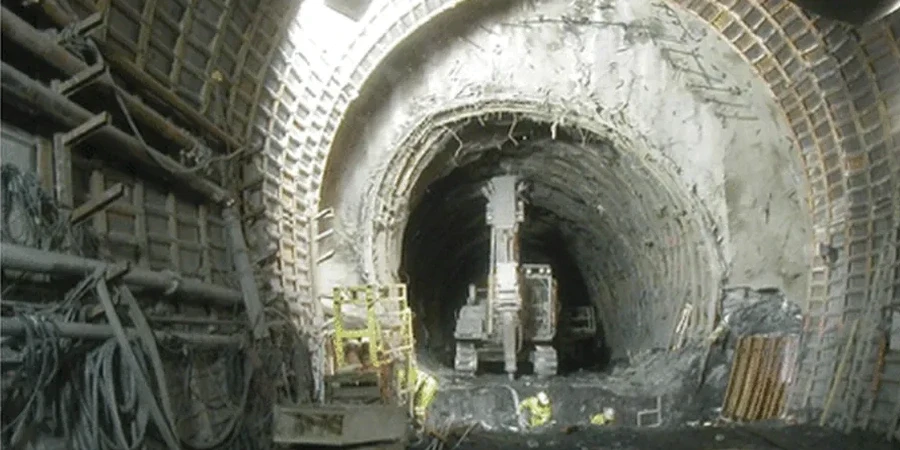
Technical reference image — Tralee

Local considerations

A common mistake on Tralee projects is assuming the silt behaves like a drained material just because it is near the surface. The permeability is too low. Undrained loading governs during tunnel advance. If you design the temporary support for drained parameters, the face collapses within hours. We have seen it happen on pilot bores west of the N21. The other error is ignoring the organic content. Peat lenses decompose and release gas when the cutterhead passes through. That changes the effective stress regime and can trigger sudden settlement at street level. Our lab quantifies both undrained strength and gas potential early. The data goes straight to the TBM operator and the temporary works designer. No shortcuts.

Need a geotechnical assessment?

Reply within 24h.

Email: contact@geotechnical-engineering.co

Technical data

ParameterTypical value
Undrained shear strength (Su)8 to 35 kPa
Sensitivity (St)4 to 12
Overconsolidation ratio (OCR)1.0 to 2.5
Compression index (Cc)0.25 to 0.70
Secondary compression index (Cα)0.008 to 0.025
Permeability (kv)1×10⁻⁹ to 5×10⁻⁸ m/s
Organic content2 to 15%
Plasticity index (PI)15 to 45%

Related services

01

Site investigation and sampling

We mobilise the CPT rig and the drilling crew to collect Shelby tubes and bulk samples across the alignment. Logging follows BS 5930. We cover Tralee town, the N21 corridor and the estuary margins.

02

Advanced laboratory testing

Consolidation, triaxial (CIU, CAU, CAD) and direct shear on remoulded and intact specimens. We measure sensitivity, permeability and secondary compression. All tests run in our accredited lab.

03

Parameter derivation for TBM design

We produce the stiffness, strength and consolidation parameters needed for face pressure calculations, settlement trough prediction and segmental lining design. Output tables are ready for PLAXIS or FLAC input.

Relevant standards

BS 5930:2015+A1:2020 – Code of practice for ground investigations, Eurocode 7 (I.S. EN 1997-1:2004) – Geotechnical design, I.S. EN ISO 17892:2014 series – Laboratory testing of soil, I.S. EN 1998-5:2005 – Seismic design of geotechnical structures

Frequently asked questions

What does a soft soil tunnel analysis cost in Tralee?

For a typical tunnel alignment in Tralee the geotechnical analysis ranges from €3,580 to €13,560. The final figure depends on the number of boreholes, the depth of sampling and the laboratory test schedule. A short pedestrian underpass needs fewer tests. A long TBM drive through the estuarine silts needs a full suite of consolidation and triaxial testing.

Which parameters matter most for a TBM in Tralee silt?

Undrained shear strength and sensitivity control face stability. Compression index and secondary compression index control settlement at surface. Permeability controls the rate of consolidation around the annulus. We measure all four on every project.

How do you handle organic layers in the Lee basin deposits?

We run loss on ignition on every tube sample to quantify organic content. Where peat is present we also measure the coefficient of secondary compression because the long-term settlement component dominates. Gas content can be flagged for the TBM contractor's risk register.

Location and service area

We serve projects in Tralee and surrounding areas.

View larger map