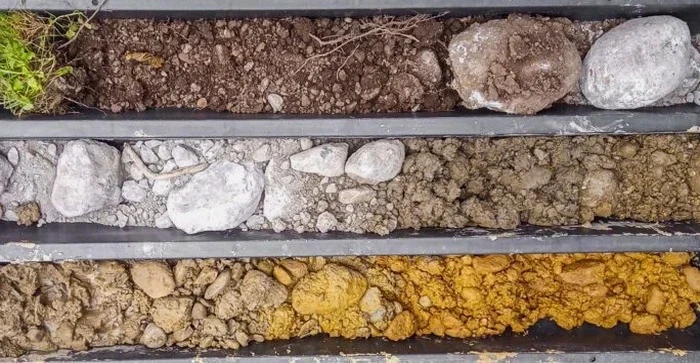
Tralee’s urban footprint expanded from its medieval core along the River Lee into the reclaimed marshlands of the Big and Small Monsters—shifting from dry limestone ridges to soft alluvial deposits in under a kilometre. That patchwork geology makes the exploratory test pit one of the most straightforward tools available for anyone building an extension, a commercial unit, or a multi-unit scheme around the town. A machine-excavated trench lets the engineering team walk up to the profile, log the strata with their own eyes, and take undisturbed samples right where the load will sit. We open these pits from Ballymullen to Mounthawk, SPT drilling adding depth when the pit can’t reach refusal, and trial pits in clay giving the same visual confidence on smaller residential lots. In a town where ground conditions shift street by street, side-stepping a physical inspection is the fastest route to an expensive surprise.
One open trench tells you more about Tralee’s subsoil than a dozen indirect tests—seeing is engineering.
FAQ
How much does an exploratory test pit cost in the Tralee area?
For a standard machine-excavated pit with engineer logging, sampling, and a factual report, the range in Tralee typically runs from €460 to €650. The final figure moves with depth, access constraints, traffic management, and the number of samples sent to the lab. A site with two or three pits usually brings the per-unit cost down.
Do I need a test pit if I already have borehole data on my Tralee site?
Boreholes give you a vertical column; a test pit gives you a continuous horizontal face. In Tralee, where fluvial and estuarine deposits can pinch out over short distances, the pit reveals lateral changes that a borehole can easily miss. Most designers request at least one pit to ground-truth the borehole interpretation, especially near the river corridor.
What safety precautions apply to deeper excavations?
Any excavation deeper than 1.25 m triggers the requirements of S.I. No. 504/2006. We bench or batter the sides, deploy a trench box where needed, run a CAT scan for buried operations before the bucket goes in, and keep the spoil at least one metre from the edge. An engineer stays at surface level unless the pit is fully supported and gas-monitored.