← Home · Laboratory

Atterberg Limits Testing in Tralee: Reliable Soil Classification

Together, we solve the challenges of tomorrow.

LEARN MORE →

With a population approaching 25,000 and a building stock that ranges from Victorian terraces on Rock Street to modern estates pushing into the townlands around Ballyard, Tralee’s subsurface is consistently challenging. The glacial tills and alluvial silts deposited by the River Lee (Tralee’s river) create soils that shift dramatically in behavior with just a few percentage points of moisture change. A standard bearing capacity check won't catch that. To predict how these silty clays will perform under load, we run Atterberg limits testing, quantifying the exact moisture contents where the soil transitions from solid to plastic to liquid. The liquid limit, plastic limit, and derived plasticity index give us a direct read on the clay mineral activity and the potential for shrink-swell movement. For ground investigations in Tralee, skipping this classification is a gamble you don’t want to take.

Tralee’s glacial clays can hold moisture for months after rainfall — the Atterberg limits tell you exactly how much water the soil can absorb before it becomes unstable.
Our approach and scope

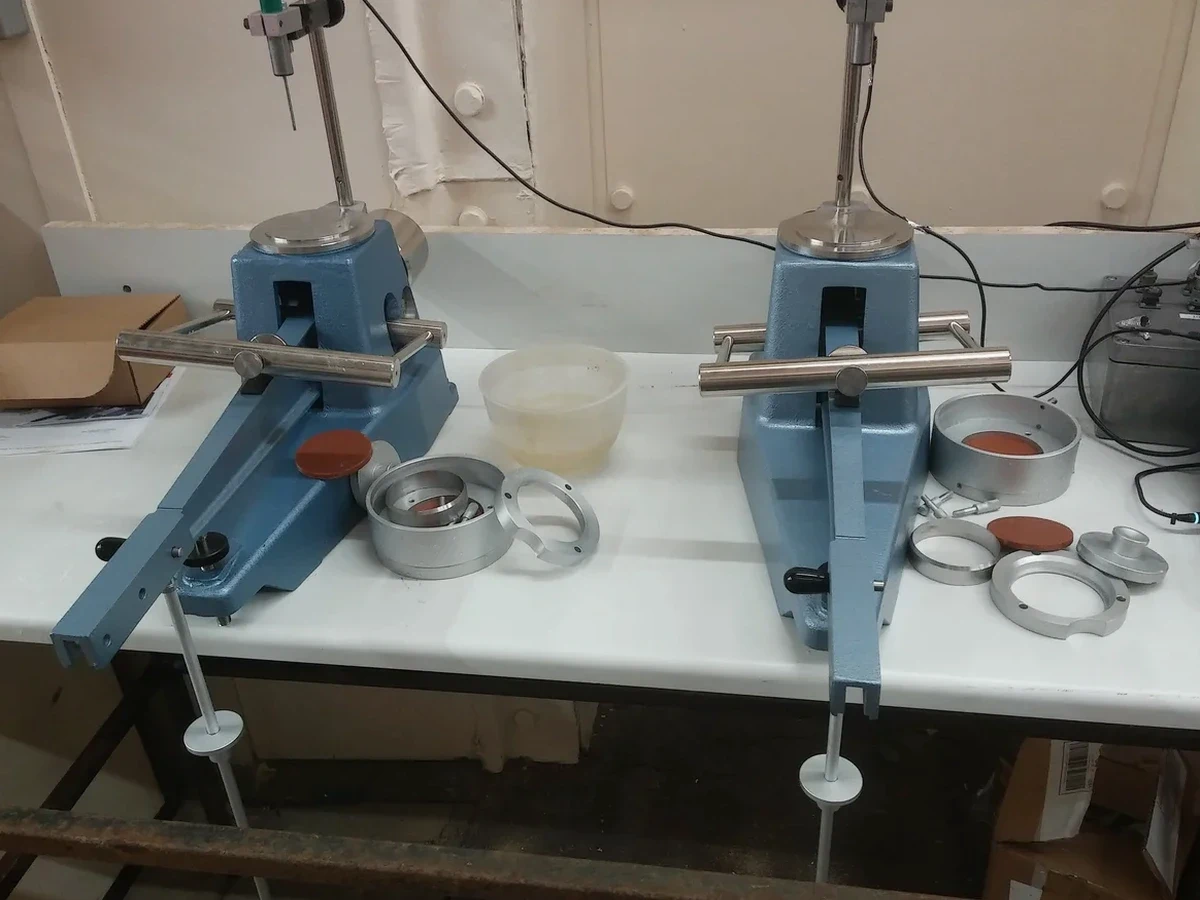
Our laboratory follows the procedures outlined in I.S. EN ISO 17892-12:2018, the Irish standard for determining liquid and plastic limits. This is particularly relevant for Tralee's boulder clays, where the fine fraction often contains a mix of low-activity rock flour and higher-activity marine clays. Using a Casagrande cup device and the standard fall-cone method for liquid limit determination, we establish precise values that feed directly into empirical foundation design correlations. We also perform the thread-rolling method for the plastic limit, ensuring repeatable results by experienced technicians. The plasticity index we calculate helps classify the soil under the Unified Soil Classification System (USCS), which is often paired with data from a grain size analysis to confirm the full gradation curve. For sites near the estuarine zones of Tralee Bay, understanding organic content and plasticity is essential before specifying any foundation type.
Atterberg Limits Testing in Tralee: Reliable Soil Classification
Technical reference image — Tralee

Local considerations

A residential extension in the Caheranne area ran into trouble when the contractor assumed the ground was a stiff boulder clay. They opened the excavation in October after a wet autumn and found the base was soft and pumping. Core samples taken just two meters down showed a liquid limit of 52% — the clay was already near its plastic state. The original strip footing design had to be abandoned in favor of a deeper trench fill solution with a geotextile separator. This is a classic Tralee scenario: a competent-looking soil that loses all bearing strength once water content exceeds the plastic limit. Without testing the Atterberg limits early, the project lost three weeks and incurred significant redesign costs. On any site with cohesive soil, the plasticity index is your first indicator of potential volume change and loss of shear strength under saturated conditions.

Need a geotechnical assessment?

Reply within 24h.

Email: contact@geotechnical-engineering.co

Technical data

ParameterTypical value
Liquid Limit (LL) Test MethodCasagrande Cup & Fall-Cone (I.S. EN ISO 17892-12)
Plastic Limit (PL) Determination3 mm Thread Rolling Technique
Plasticity Index (PI)Calculated (LL - PL)
Liquidity Index (LI)Calculated from in-situ moisture content
Clay ActivityPI / % Clay Fraction
Sample PreparationWet sieving through 425 µm sieve
Reporting StandardI.S. EN 1997-2 (Eurocode 7 - Part 2)

Related services

01

Classification Testing Suite

Combining Atterberg limits with particle size distribution and moisture content to provide a full soil classification under the Irish Annex of Eurocode 7.

02

Shrink-Swell Potential Assessment

Using the plasticity index and clay fraction to predict volume change potential in Tralee's glacial tills, critical for lightly-loaded foundations and road subgrades.

03

Site Investigation Support

We provide sampling kits, schedule collection, and deliver results within agreed timescales, with direct engineering commentary on the implications for foundation design.

Relevant standards

I.S. EN ISO 17892-12:2018 — Geotechnical investigation and testing — Laboratory testing of soil — Part 12: Determination of liquid and plastic limits, I.S. EN 1997-2:2007 (Eurocode 7 — Geotechnical design — Part 2: Ground investigation and testing), BS 1377-2:1990 (still referenced for historic comparisons in some Irish projects)

Frequently asked questions

What do Atterberg limits actually measure?

They measure the moisture contents at which a fine-grained soil changes state. The liquid limit is the water content where the soil flows like a liquid. The plastic limit is where it crumbles rather than deforms plastically. The difference between them — the plasticity index — tells you how sensitive the soil is to water content changes.

How much does Atterberg limits testing cost in Tralee?

For a standard set of Atterberg limits (liquid limit, plastic limit, and plasticity index) on a single sample, you're typically looking at €60 to €110. The price varies depending on whether it's part of a larger testing package and how quickly you need the results.

Why can’t I just use a simple field test instead of lab testing?

Field tests give you an indication but not the numbers you need for design. A hand test might tell you the soil feels plastic, but it won’t give you a PI of 22% to plug into bearing capacity equations or swell potential charts. For any permanent works in Tralee, the local authority building control will want test certificates from an accredited lab.

Location and service area

We serve projects in Tralee and surrounding areas.

View larger map