← Home · In-Situ Testing

Field Density Testing in Tralee – Sand Cone Method for Earthwork Compliance

Together, we solve the challenges of tomorrow.

LEARN MORE →

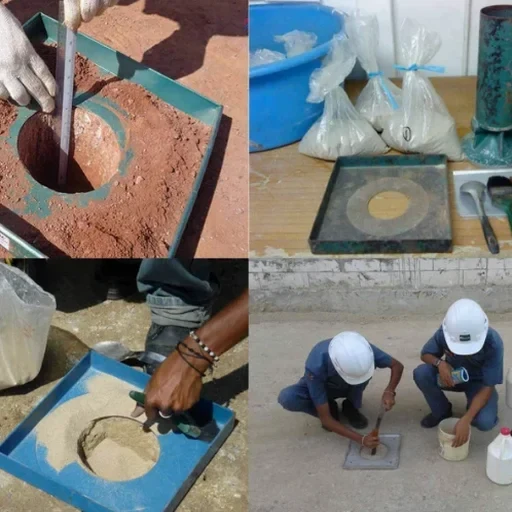
Tralee sits on a low-lying limestone basin where glacial till and alluvial silts from the River Lee create a compact but moisture-sensitive subgrade. The Atlantic influence means rainfall exceeds 1,100 mm annually, and that persistent dampness is what drives the need for rigorous field density testing on every earthworks project. When a contractor places engineered fill for a new housing estate near the Aquadome or a road widening along the N69, the sand cone method remains the most direct way to verify that each lift meets the specified compaction target. The technique uses clean, dry, uniformly graded Ottawa-type silica sand, calibrated through a UKAS-accredited laboratory before every site campaign, giving the resident engineer confidence that the readings reflect true in-place density rather than a laboratory ideal. For deeper formation control, the programme often integrates a plate load test to confirm bearing response at final grade, and when the underlying soil stratigraphy is uncertain, a test pit investigation provides visual correlation with the compaction log.

Compaction is the cheapest structural improvement you can give a soil, and the sand cone test is the only field method that lets you measure it directly without a nuclear gauge.

Our approach and scope

On sites across Tralee, from the Ballymullen area to the Clash industrial estate, the most common question from groundworkers is whether the moisture content of the local boulder clay is distorting the sand cone result. The answer depends entirely on the calibration routine and the operator’s refusal to cut corners. Our technicians pre-weigh every sand jug to 0.1 g resolution, run a cone-density calibration on a flat glass plate at the start and close of each shift, and extract a sealed moisture-content sample from the centre of the test hole immediately after the sand volume is recorded. The excavated material goes through a full grain size analysis when the specification demands it—for instance, on NRA-funded road schemes where the 600 mm capping layer must meet Clause 806 compaction criteria. In practice, this means a single test location yields three independent checks: dry density from the sand cone, moisture ratio from the oven-dried specimen, and particle-size distribution from the washed sieve stack. The process takes less than 20 minutes per station, yet the data it generates anchors the entire earthworks QA chain.
Field Density Testing in Tralee – Sand Cone Method for Earthwork Compliance
Technical reference image — Tralee

Local considerations

Two sites in Tralee can be separated by less than 2 km yet show completely different compaction behaviour. The well-drained gravelly till north of the town centre near the Tralee-Fenit railway line usually achieves 95 % modified Proctor density with minimal effort, provided the moisture is close to optimum. By contrast, the silty alluvium along the Big River floodplain east of Manor West Retail Park holds water stubbornly and can fail a density test even after multiple roller passes because the pore pressure bleeds out slowly. The risk is not the test method itself; it is assuming that one compaction specification fits all materials. When the sand cone result falls below 93 % relative compaction on a silty formation, the corrective action must be based on local knowledge—sometimes a switch to a sheepsfoot roller, sometimes a lime stabilisation decision that only makes sense after the atterberg limits have been measured on the borderline material.

Need a geotechnical assessment?

Reply within 24h.

Email: contact@geotechnical-engineering.co

Technical data

ParameterTypical value
Test standardBS 1377-9:1990 (sand replacement method – large pouring cylinder)
Sand calibrationUKAS-accredited lab; bulk density & particle density verified per BS 1377-2
Hole depth range100–250 mm, depending on maximum particle size and lift thickness
Maximum particle size37.5 mm (one-third of hole diameter for standard 115 mm cone)
Moisture content methodOven-dried at 105 °C ± 5 °C; comparison with Speedy moisture meter on site
Typical testing frequency1 test per 500 m² per compacted lift on earthworks; higher frequency for structural fill
Reporting turnaroundPreliminary density ratio on site; final signed report within 48 hours

Related services

01

Sand cone density test (field)

On-site dry density determination using the BS 1377-9 large pouring cylinder method, with real-time moisture correction and immediate relative compaction ratio against laboratory Proctor reference.

02

Laboratory Proctor reference

Standard and modified Proctor compaction curves (BS 1377-4) run on representative bulk samples collected from the same lift being tested, ensuring the field density ratio is benchmarked against the correct material.

03

Trench backfill verification

Targeted density testing in narrow excavations for sewer, watermain and ESB duct installations, where the sand cone method is often the only practical option because of confined access.

Relevant standards

BS 1377-9:1990 – Methods of test for soils for civil engineering purposes – In-situ tests, NRA MCDRW Series 600 – Specification for Road Works: Earthworks (now TII), IS EN 1997-2:2007 – Eurocode 7: Geotechnical design – Ground investigation and testing, BS 1924-2:2018 – Hydraulically bound and stabilised materials for civil engineering purposes

Frequently asked questions

How much does a field density test cost in Tralee, and what does the rate include?

A single sand cone density test in Tralee typically ranges from €90 to €110, depending on the number of locations and whether the laboratory Proctor reference is already established. The rate covers the technician, calibrated sand, on-site moisture determination, a preliminary density ratio handed over before leaving site, and the final signed PDF report. Mobilisation to sites within 20 km of Tralee is usually included; longer runs to Dingle or Listowel are quoted separately.

What is the minimum hole depth for a reliable sand cone test in silty Kerry soils?

The hole depth should be at least 100 mm, and ideally equal to the compacted lift thickness—typically 150 mm for capping and 200–250 mm for general fill. In Tralee's silty alluvium, a shallow 80 mm hole tends to overestimate density because it samples the crust rather than the full lift, so the BS 1377-9 procedure specifies a minimum depth of at least four times the maximum particle size.

Can the sand cone method be used on trench backfill with ESB ducts already installed?

Yes, it is often the only practical method in that situation. The sand cone equipment fits around duct banks and service crossings where a nuclear gauge would produce unreliable readings near the plastic conduit. The key precaution is to calibrate the sand for the smaller hole volume and to hand-excavate carefully so the duct is not disturbed, which would invalidate the volume measurement.
Location and service area

We serve projects in Tralee and surrounding areas.

View larger map