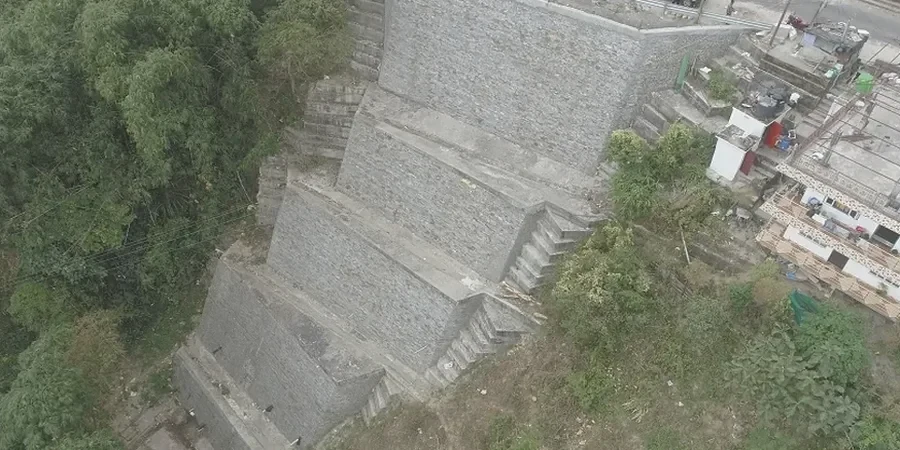
A residential development on the elevated ground overlooking Tralee Bay recently faced a critical planning condition: demonstrate long-term slope stability before foundations could be poured. The site sat on glacial till overlying shale bedrock, a common profile across the Lee Valley, and the 12-meter cut proposed for the access road triggered a thorough geotechnical review. In Tralee, where the terrain transitions from the sandstone ridges of the Slieve Mish into the low-lying basin of the River Lee, understanding the equilibrium between natural slopes and engineered excavations is not optional—it is a prerequisite for any project that alters the ground profile. We deployed a combination of rotary cored boreholes and piezometer installations to characterize the subsurface, then constructed a limit equilibrium model calibrated to actual groundwater levels measured during a wet Kerry winter, because nothing predicts failure like water pressure in a thinly bedded formation. This integrated approach, merging in-situ permeability data with triaxial testing on undisturbed samples, gives developers and local authorities the confidence that a slope will remain stable for the design life of the structure.
A slope in Tralee doesn't fail because the soil is weak; it fails because water found a path nobody modelled.
Regional considerations
Tralee occupies a geological boundary where the high ground of the Dingle Peninsula meets the alluvial flats of the River Lee, a setting that creates two distinct slope failure regimes. On the hillsides, shallow translational slides develop at the interface between colluvium and weathered bedrock during prolonged rainfall, exactly the conditions that prevail from October through March when monthly precipitation exceeds 150 mm. In the river valley, the risk shifts to rotational failures in soft silty clays where excavation for basements or bridge abutments removes the toe support that the slope has relied on since the last glaciation. The most dangerous scenario we encounter is the construction cut that exposes a slickensided shear surface in the underlying mudstone—a relic of ancient slope movement that reactivates when the cut steepens the gradient beyond the residual friction angle. Our field mapping in Tralee has documented such features in several townland quarries, and we now routinely specify inclinometer monitoring for any permanent cut exceeding 6 meters in height adjacent to public infrastructure or occupied buildings.
FAQ
What is the typical cost of a slope stability analysis for a single-house development in Tralee?
For a single dwelling on a sloping site in the Tralee area, a slope stability analysis typically ranges from €1,160 to €3,960. The final figure depends on the height of the proposed cut, the complexity of the ground conditions, and whether a site investigation with boreholes and laboratory testing is required. A desk study with a walkover survey and simple infinite slope analysis sits at the lower end, while a full investigation with monitoring instrumentation and numerical modelling is at the upper end.
How long does a slope stability investigation take from instruction to final report?
A typical programme runs four to six weeks. The first week covers the desk study and site reconnaissance. Mobilising a drilling crew and completing the fieldwork in Tralee usually takes another week, assuming reasonable weather. Laboratory testing on the recovered samples requires two to three weeks for triaxial and classification tests. The analysis and report writing then take one to two weeks. Projects requiring longer-term piezometer monitoring to capture winter groundwater levels may extend the timeline by several months.
Which design standard governs slope stability analysis in Ireland?
I.S. EN 1997-1:2004, the Irish adoption of Eurocode 7 Part 1, is the primary standard for geotechnical design. It defines three geotechnical categories based on complexity and risk, which determine the required level of investigation and analysis. The Irish National Annex provides specific partial factors for soil parameters and resistances. For seismic considerations, I.S. EN 1998-1 applies, though Tralee's low seismicity means seismic loading rarely governs the design.
Can you assess an existing slope that shows signs of instability, such as cracking or leaning trees?
Yes, condition assessments of existing slopes are a core part of our work in Tralee. We map the extent of tension cracks, measure any lateral displacement using inclinometers or survey markers, and install piezometers to understand the groundwater regime driving the movement. By back-analysing the observed failure geometry, we can estimate the in-situ shear strength and determine whether the movement is a first-time failure or a reactivation along a pre-existing shear surface. The findings guide the design of remedial measures such as drainage improvements, toe berms, or retaining structures.