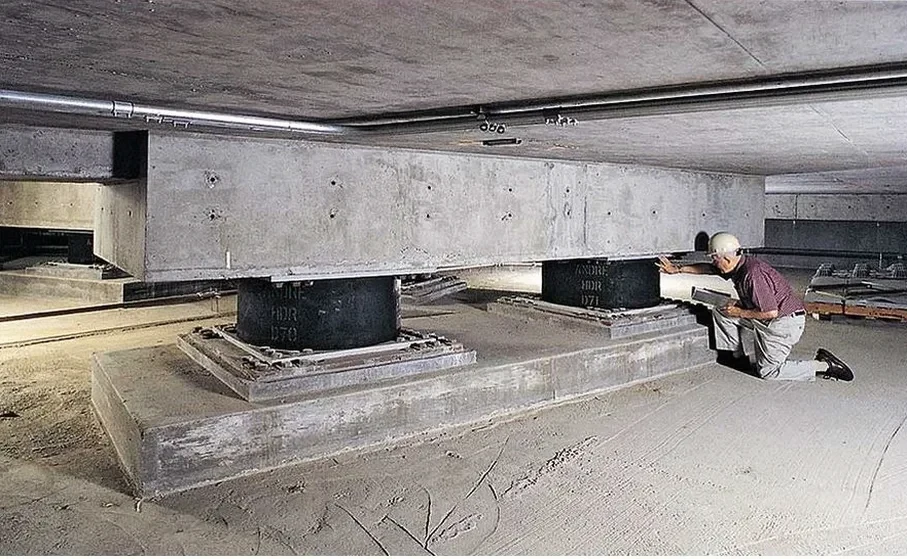
Tralee sits at just 4 meters above sea level, spread across the floodplain of the River Lee where soft alluvial clays and silts dominate the subsurface. With a population north of 23,000 and growing, new commercial and residential developments are pushing into areas where ground conditions amplify even moderate seismic waves. The last significant tremor felt in Kerry was the 2013 Irish Sea event at magnitude 3.8, but the real concern here is not frequent shaking—it is the combination of soft soil amplification and the long-period energy from distant offshore faults. Under Eurocode 8 Part 1 (EN 1998-1:2004), base isolation seismic design becomes the most rational strategy when a conventional fixed-base structure would demand oversized sections and costly foundation upgrades. We approach every Tralee project by first mapping the dynamic soil properties through seismic microzonation to confirm the spectral acceleration at bedrock and surface, then designing the isolation interface to shift the structure's fundamental period well beyond the soil's predominant period. The result is a building that moves very little while the ground beneath it does the work.
A well-tuned isolation system in Tralee can cut the base shear demand by 60 to 80 percent compared with a fixed-base solution on soft alluvium.
Relevant standards
I.S. EN 1998-1:2005 (Eurocode 8, Part 1) + Irish National Annex, I.S. EN 15129:2018 (Anti-seismic devices), I.S. EN 1992-1-1:2004 (Eurocode 2, concrete pedestal design), I.S. EN 1337-3:2005 (Structural bearings – elastomeric), I.S. EN 1997-1:2004 (Eurocode 7, geotechnical design)
FAQ
What is the typical cost of a base isolation seismic design package for a mid-rise building in Tralee?
For a typical three-to-four-storey commercial or residential building in Tralee, the full design package—including seismic hazard analysis, isolation system design, non-linear time-history analysis, and testing specifications—runs between €3,980 and €7,190 depending on the structural complexity and the number of ground-motion pairs required. The isolator hardware cost is separate and driven by the number and diameter of bearings.
Can base isolation be retrofitted to an existing building in Tralee, or is it only for new construction?
Retrofit isolation is absolutely feasible and we have applied it to heritage structures where interrupting occupancy was not an option. The methodology involves temporarily supporting the building on hydraulic jacks, cutting the columns at a common horizontal plane, inserting the isolators, and transferring the load back down. It requires careful sequencing and a detailed survey of the existing reinforcement, but it is a proven technique under I.S. EN 1998-3.
How does the soft alluvial soil in Tralee affect the isolation design compared with a rock site?
The soft silts and clays under Tralee amplify long-period motion and shift the spectral peak toward longer periods. That means we must select isolators with a post-elastic period long enough to stay well to the right of the amplified peak—usually targeting 2.5 to 3.0 seconds—and we must account for larger total displacements because the ground motion contains more energy in the 0.5–1.5 second band than a rock site would.