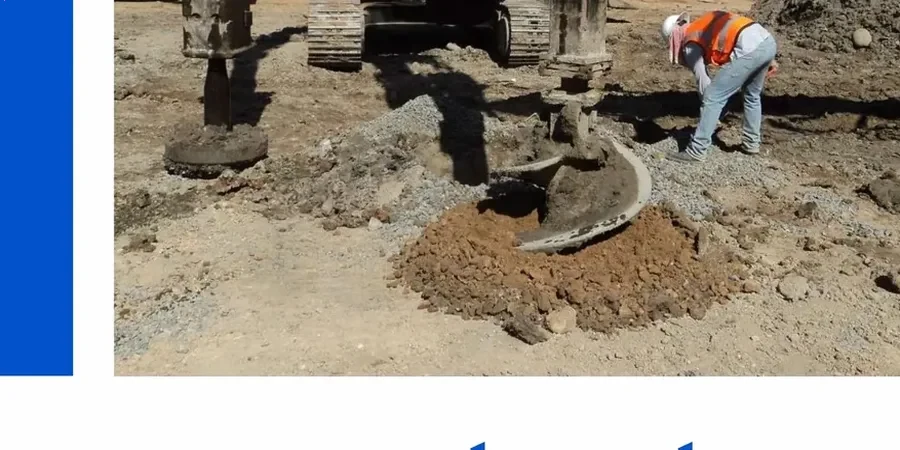
We still see projects around Tralee where contractors try to build directly on the soft silts and peat pockets that run through the Lee Valley — and then wonder why differential settlement shows up within the first two years. The fix isn't thicker footings or more rebar; it's ground improvement at depth. Stone column design changes the load path entirely, transferring stress through compacted gravel elements into the stiffer layers below. Done right, it cuts total settlement by 40 to 60 percent compared to untreated ground. For warehouse slabs, apartment blocks, and embankment fills near the River Lee floodplain, we combine site-specific CPT testing data with column geometry modelling to deliver a design that the installer can actually execute — not just a theoretical layout. Every design package includes column spacing, diameter, depth, gravel specification, and a verification testing schedule aligned with IS EN 14731:2005.
A properly designed stone column grid in Tralee's soft alluvium typically reduces post-construction settlement by half — and eliminates the need for deep piling in low to mid-rise structures.
Our approach and scope
The geology under Tralee tells the story: a thick sequence of post-glacial alluvium — soft clays and silty sands — deposited over limestone bedrock that can sit anywhere from 6 to 18 metres below ground level. Groundwater is typically within 1.5 metres of the surface, which complicates excavation and makes dry-bottom methods impractical. That's why the wet top-feed method predominates here. For one recent project on the north side of town, the profile showed 11 metres of very soft clay with undrained shear strength below 20 kPa — classic candidate for vibro-replacement. We sized the columns at 800 mm diameter on a 2.1 m triangular grid, using clean angular stone with a Los Angeles coefficient below 30. Where column groups interact with existing services or adjacent foundations, we run the numbers through axisymmetric finite element models to check stress concentration ratios. In areas where the treatment depth is limited by shallow bedrock, we sometimes recommend combining stone columns with a vibrocompaction pass in the upper granular layer to improve inter-column stiffness before placing the load transfer platform.
Regional considerations
We reviewed a project on the outskirts of Tralee where the engineer had specified a uniform column grid across the entire site — but the ground investigation logs told a different story. The northern third of the site sat on 4 metres of organic silt with loss-on-ignition above 8 percent, while the rest was firm sandy clay. Organic soils don't carry out the same lateral confinement for stone columns; the bulge mechanism changes and the settlement reduction ratio drops sharply. Without a zoned design, that building would have tilted within five years. The risk isn't just geotechnical — it's contractual. When the design doesn't match the ground variability, the installer gets blamed for poor performance, and the client pays for remedial underpinning. We zone every design by sub-area, specify minimum column toe depth into competent bearing stratum, and require zone-specific trial columns with load testing before production starts. In Tralee's variable ground conditions, skipping that step is a liability no one needs.
Relevant standards
IS EN 14731:2005 — Execution of special geotechnical work. Ground treatment by deep vibration., Eurocode 7 (EN 1997-1:2004) — Geotechnical design (Irish National Annex I.S. EN 1997-1/NA:2010), IS EN 1998-5:2004 — Eurocode 8: Design of structures for earthquake resistance. Foundations., ICE Specification for Ground Treatment (Institution of Civil Engineers, UK best practice), I.S. EN ISO 22476-1:2012 — Geotechnical investigation and testing. Field testing.
FAQ
What does stone column design cost for a project in Tralee?
For sites in Tralee, the engineering design package typically falls between €1,460 and €4,820, depending on the treated area, the number of geological zones, and whether finite element modelling is required for complex loading or interaction with existing structures. Smaller residential sites with uniform ground conditions sit at the lower end; larger commercial developments with variable stratigraphy and multiple column zones move toward the upper range. The fee covers the full design report, settlement calculations, column layout drawings, stone specification, and a verification testing schedule. We carry out a fixed-price proposal after reviewing your ground investigation data — no hidden costs for revisions within the agreed scope.
How do you verify that the stone columns are performing as designed?
Verification follows a two-stage approach. During installation, we monitor column depth, stone consumption per metre, and amperage or vibration records to confirm consistent compaction. Post-treatment, we specify zone-based testing — typically plate load tests on single columns and column groups to measure load-settlement response, supplemented by CPT profiles through the treated zone to check improvement in tip resistance and sleeve friction. For critical structures, we sometimes add cross-hole seismic testing to confirm shear wave velocity increase. The acceptance criteria are defined in the design report and referenced to IS EN 14731:2005.
What ground conditions in Tralee make stone columns suitable?
Tralee sits on soft post-glacial alluvium — clays, silts, and occasional peat lenses — over limestone bedrock. Stone columns work well where the undrained shear strength of the cohesive soil is between 15 and 50 kPa, and the treatment depth is at least 4 to 6 metres. They're less effective in very organic soils (loss-on-ignition above 10%) or where the groundwater is too aggressive for the stone fill. We assess suitability during the feasibility stage using site-specific CPT and laboratory data, and we'll tell you honestly if another technique — such as rigid inclusions — would perform better for your particular ground profile.
How long does the design process take from start to finish?
For a typical project in Tralee with existing ground investigation data, the preliminary feasibility analysis takes 3 to 5 working days. The full detailed design — including settlement modelling, column layout drawings, and method statement — is usually completed within 10 to 15 working days after receiving all input data. Complex sites requiring finite element analysis or iterative coordination with the structural engineer may extend the timeline by an additional week. We always confirm the schedule in writing before starting, and we can accommodate urgent timelines when the contractor is mobilising.