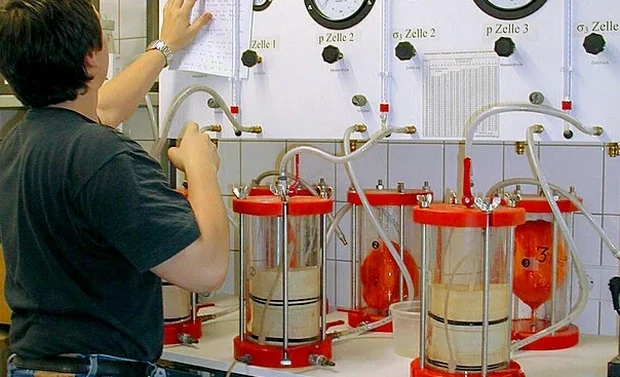
Designing a pavement in Tralee means accounting for two fundamentally different ground conditions that exist just a few kilometres apart. The compact glacial tills underlying the town centre and Ballyseedy tend to deliver reliable bearing capacity once properly compacted, while the alluvial silts along the River Lee floodplain near Blennerville exhibit far lower stiffness and demand careful CBR verification. This contrast becomes critical when specifying sub-base thickness for access roads servicing new residential developments around the Tralee-Fenit greenway corridor. A laboratory CBR test run under controlled moisture and density conditions provides the soaked strength value that feeds directly into pavement design catalogues, removing the guesswork that leads to premature rutting. We complement this with grain size analysis to confirm fines content and Atterberg limits to flag plasticity risks before compaction begins.
A soaked CBR of 3% versus 8% can double the required pavement thickness — that difference alone justifies a €200 laboratory test on every subgrade material in Tralee.
FAQ
What does a laboratory CBR test cost in Tralee?
A standard soaked CBR test on a single sample ranges from €100 to €220, depending on whether compaction curve determination is included. Testing three points for a full moisture-density relationship increases the total. We carry out a fixed quote before work begins, with no hidden charges for swell measurement or penetration curve reporting.
How long does it take to get CBR results for a pavement design submission?
The soaking period alone requires 96 hours. Including sample preparation, compaction, soaking, penetration testing, and reporting, the standard turnaround is 5 working days. We can expedite to 4 days when project schedules demand it, though the soak duration cannot be shortened without compromising the test's validity under I.S. EN 13286-47.
Can you test CBR on site in Tralee or is it laboratory only?
The formal soaked CBR test is exclusively a laboratory procedure because it requires controlled compaction into a rigid mould and a 96-hour water bath. For rapid field assessment, we offer the Dynamic Cone Penetrometer as a complementary in-situ index, which we then correlate against laboratory CBR values from the same formation. This is particularly useful on linear projects like the Tralee Bypass where conditions change frequently.