← Home · Roadway

Rigid Pavement Design in Tralee: Concrete Roads & Heavy-Duty Surfaces

Together, we solve the challenges of tomorrow.

LEARN MORE →

Last year we reviewed a failed warehouse yard outside Tralee. The original slab had been poured on what looked like solid ground—but six months later, it was cracked corner to corner. Turned out the subgrade was layered over a thin solution feature, classic Kerry karst. Rigid pavement design needs more than a standard CBR value around here. We look at the whole profile: the limestone bedrock, the overburden, the drainage pattern. If the support isn't uniform, the concrete slab works in flexure in ways the thickness calculations never anticipated. Before we touch a mix design, we run a test pit programme to map the depth to rock, and often combine it with CPT testing where access allows, to get a continuous stiffness profile without missing soft lenses.

A concrete slab on karst is a bridge deck in disguise—design it for what's not there underneath.

Our approach and scope

Tralee's rainfall—over 1,200 mm annually—and its underlying karst geology create a specific challenge for concrete pavements. Water doesn't just affect the surface; it moves through fissures in the limestone, saturates the subgrade, and can erode fine particles from beneath a slab. A rigid pavement design that works in Dublin won't necessarily hold up here. We specify joint layouts and reinforcement based on the expected thermal gradient and the moisture regime. For industrial pavements taking forklift loads or container stacking, we move beyond the standard IRC or TRL catalogues. The plate load test becomes essential on sites where the rockhead is irregular—you need the modulus of subgrade reaction measured in situ, not inferred from a correlation. We also check the drainage layer gradation against the grain size analysis of the local subgrade to prevent migration of fines into the sub-base, a common failure mechanism we've seen in several Kerry industrial estates. The slab isn't just a wearing course; it's a structural element, and we design it accordingly.
Rigid Pavement Design in Tralee: Concrete Roads & Heavy-Duty Surfaces
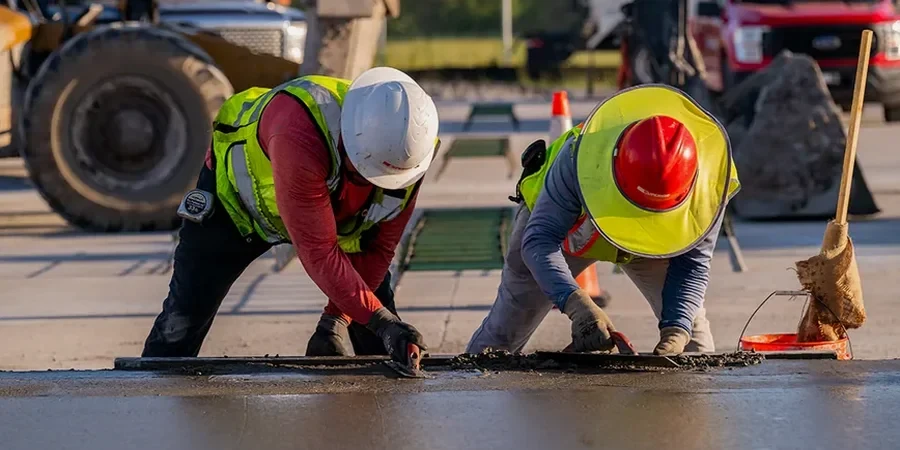
Technical reference image — Tralee

Local considerations

Tralee's expansion along the N21 and into the former marshlands around the River Lee presents a legacy of variable fill. Some of the older industrial plots were raised with whatever was available—often a mix of quarry scalpings and silty material. That heterogeneity under a rigid pavement leads to differential settlement, and concrete doesn't tolerate much differential movement before it cracks. We've seen cases where a perfectly good concrete mix failed because the subgrade reaction modulus varied by 40% across the slab footprint. The other risk is chemical attack: acidic peat layers, common on the margins of Tralee, can degrade the sub-base and even attack the concrete itself over time. A design that skips subgrade stabilisation or a proper separation geotextile is gambling with a five-figure repair bill. Our approach includes a site-specific sulfate and pH assessment before finalising the pavement section.

Need a geotechnical assessment?

Reply within 24h.

Email: contact@geotechnical-engineering.co

Watch the video

Technical data

ParameterTypical value
Design standardI.S. EN 1992-1-1 & NRA DMRB
Slab thickness range150 mm – 300 mm
Joint spacing4.0 m – 6.0 m
Modulus of subgrade reaction (k)Measured via plate load test
Concrete strength classC28/35 – C40/50
Load classificationUp to 180 kN axle load
Drainage layerOpen-graded, min 150 mm thick

Related services

01

Industrial Yard Pavement Design

Full design for concrete yards handling forklifts, reach stackers, and container loads. We model point loads and fatigue, specify joint layout, and detail the sub-base and drainage layer.

02

Road & Access Pavement Design

Design to NRA DMRB standards for rigid access roads, bus lanes, and junction boxes. Includes tie-bar and dowel bar schedules for longitudinal and transverse joints.

03

Subgrade Assessment & Stabilisation

Plate load testing, CBR correlation, and chemical analysis of the subgrade. Where karst features or soft ground are found, we design lime stabilisation or a reinforced geogrid layer.

Relevant standards

I.S. EN 1992-1-1:2004 (Design of concrete structures), NRA DMRB HD 26/06 (Pavement design for national roads), I.S. EN 206-1:2013 (Concrete specification), BS 8500-1:2015 (Complementary concrete standard), TRL Road Note 29 (Industrial pavement design guide)

Frequently asked questions

What's the typical cost for a rigid pavement design in Tralee?

For a standard industrial yard or access road in the Tralee area, the design package—including ground investigation, subgrade assessment, structural calculations, and jointing plans—typically runs from €1,710 to €5,380, depending on the area and the complexity of the karst conditions. A simple slab on uniform ground sits at the lower end; a heavily reinforced pavement over variable rockhead with a full drainage and stabilisation design moves toward the upper end.

How long does the design process take from start to finish?

A typical rigid pavement design project in Tralee takes three to four weeks. The first week covers the site investigation—test pits, plate load tests, and sampling. The second and third weeks are for laboratory testing of the subgrade and concrete mix design verification. The final week produces the detailed drawings and jointing schedules. If the ground investigation reveals unexpected karst features, we may need an extra week for supplementary testing and design iteration.

Do you handle the construction supervision as well, or just the design?

We can provide construction-phase support: checking the subgrade preparation before the sub-base goes down, verifying the reinforcement placement, and monitoring the concrete pour and curing. We don't take on the main contractor role, but we act as the designer's representative on site to ensure the slab gets built to the specification. This is particularly useful on Tralee sites where the ground conditions can change between design and construction.
Location and service area

We serve projects in Tralee and surrounding areas.

View larger map