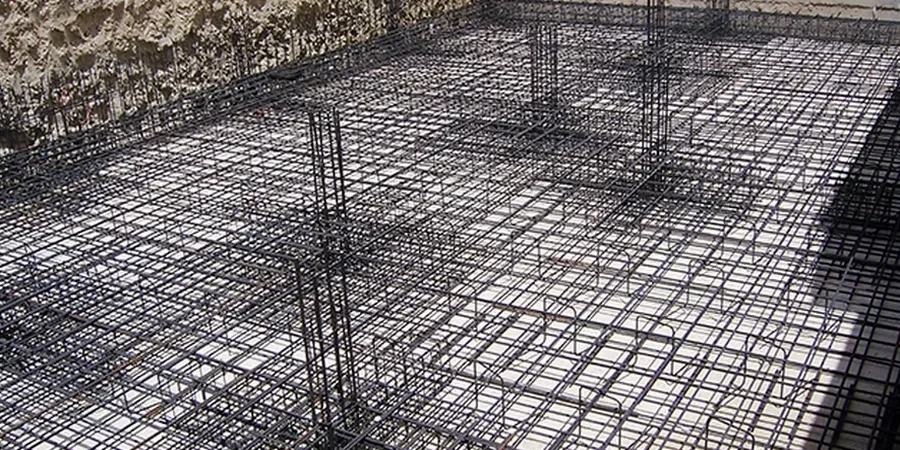
Raft foundation design in Tralee must account for the specific depositional environment of the River Lee floodplain and the underlying Dinantian limestone bedrock. I.S. EN 1997-1:2004+A1:2013 (Eurocode 7) governs the geotechnical design, requiring serviceability and ultimate limit state verification. Tralee's average annual rainfall exceeds 1,200 mm, so permanent groundwater control and buoyancy checks are non-negotiable. The town sits at roughly 10 metres above sea level, and the variable thickness of soft alluvial clays over karst limestone demands a rigid approach to soil-structure interaction. Our team integrates site-specific parameters from an in-situ permeability test programme with detailed bearing capacity assessments to deliver a unified raft design that mitigates differential settlement.
A single continuous raft eliminates the risk of independent footing rotation in Tralee's layered alluvium—settlement stays uniform, even when soil stiffness varies by 30% across the plan.
Regional considerations
The most persistent error we see in Tralee is designing a raft with a uniform bearing pressure assumption while ignoring the softening of the upper clay crust during wet winters. When the water table rises to within 0.5 m of formation level, the undrained shear strength can drop below 40 kPa, triggering a punching failure if the raft edge is not deepened or provided with a perimeter toe beam. Another frequent mistake is skipping a targeted karst investigation; a single dissolution feature beneath a corner of the raft can produce angular distortion exceeding 1/500, cracking partition walls. We enforce the observational method as permitted by Eurocode 7, with settlement markers and piezometers installed before concrete placement, so that any deviation from the design model is captured during the first loading cycle.
Relevant standards
I.S. EN 1997-1:2004+A1:2013 (Eurocode 7: Geotechnical design), I.S. EN 1992-1-1:2004+A1:2014 (Eurocode 2: Design of concrete structures), I.S. EN 1998-1:2005+A1:2013 (Eurocode 8: Seismic design, Irish National Annex), BRE Digest 471 (Modulus of subgrade reaction guidance), I.S. EN ISO 22475-1 (Geotechnical investigation and sampling)
FAQ
What ground investigation data do you need before designing a raft for a Tralee site?
As a minimum, we require borehole logs with SPT N-values and recovered samples for classification tests (PSD, Atterberg limits), plus groundwater monitoring over at least one wet season. For sites east of Tralee town centre where peat lenses are common, we strongly recommend CPT profiles and a geophysical survey to map bedrock depth. All testing must follow I.S. EN ISO 22475-1 and be supervised by a chartered geotechnical engineer.
How much does a raft foundation design typically cost for a residential project in Tralee?
For a single dwelling or small extension on a standard plot, the structural and geotechnical design package usually falls between €930 and €4,200, depending on the complexity of the ground conditions, the number of boreholes required, and whether karst probing is needed. A site with known dissolution features or a high water table will be at the upper end of that range because of the additional analysis and detailing.
Can a raft foundation be used on a sloped site in Tralee?
Yes, but it requires a stepped or sloped raft detail with careful earth pressure checks on the downhill side. We design the step locations to coincide with column grids, and we verify sliding stability under drained conditions using the residual friction angle of the fill. On gradients steeper than 1:10, we often combine the raft with a retaining wall to reduce excavation and maintain frost protection depth.