The first piece of kit we mobilize for a deep excavation design in Tralee is the CPT rig, specifically a 20-tonne tracked unit capable of pushing through the dense glacial tills that underpin the town. Tralee sits on a complex geology dominated by the underlying Namurian shales and sandstones, but the immediate subsurface is often a highly variable sequence of estuarine silts and clays deposited by the River Lee's floodplain. CPT testing allows us to rapidly profile these soft, often underconsolidated layers, pinpointing the exact depth to competent bearing strata without the disturbance caused by traditional boring. Given the town's compact urban core, where projects like the redevelopment around the Square require deep basements right up against existing structures, we rely on continuous real-time data capture to refine our model on the fly. The rig's small footprint lets us work in tight backlots off Rock Street, feeding geotechnical parameters directly into our finite element analysis before the drillers even demobilize.
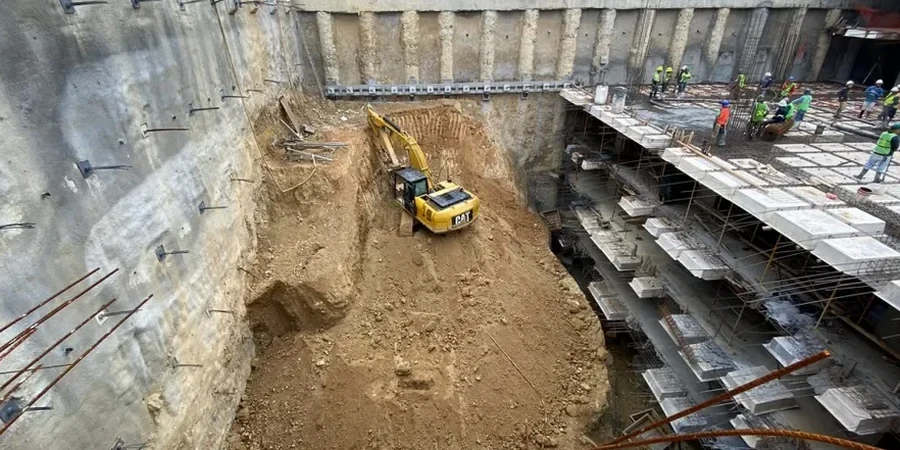
In Tralee's layered geology, a 15-metre excavation isn't a hole in the ground—it's a five-sided pressure vessel demanding 3D staged analysis to prevent basal heave in the underlying silt.
Regional considerations
The constant Atlantic humidity and Tralee's average annual rainfall of over 1,100 mm demand a radically different approach to excavation support than inland sites. Weathered shale in the Tralee area loses significant shear strength upon exposure to air and moisture, a process known as slaking, which can degrade a temporary bench left open for even a week. This climatic reality forces our designs to incorporate a rapid 'seal coat' of shotcrete immediately after excavation, specified within a 12-hour window regardless of the weather forecast. Furthermore, the proximity of the Tralee Bay estuary means that groundwater levels respond not just to rainfall but to tidal lag, a nuance we capture with vibrating wire piezometers connected to a cloud-based data logger. Ignoring this tidal influence in the hydraulic boundary conditions can lead to a gross underestimation of pore pressures at the toe of the wall, making a basal heave failure nearly inevitable during a spring tide.
FAQ
How do you account for the soft silts when designing a basement excavation in Tralee town centre?
We specifically target the estuarine silts with in-situ piezocone (CPTu) testing to measure the undrained shear strength (Su) and overconsolidation ratio (OCR). Using the 'SHANSEP' method or critical state soil mechanics, we correct the shear strength for the excavation unloading path, ensuring our finite element model accurately predicts the lateral wall movement and basal heave stability under the low effective stress conditions.
What is the typical cost range for the geotechnical design package of a deep excavation in Tralee?
For a comprehensive design package covering ground investigation specification, temporary works design, and construction-phase monitoring interpretation, costs generally range between €1,900 and €6,460. The final figure depends entirely on the excavation's footprint, the number of retained faces, and the complexity of the groundwater regime.
Can you design an excavation support system that avoids anchors going under my neighbour's property?
Absolutely. In Tralee, where land boundaries are tight, we frequently design cantilever or internally propped walls using raking props or a 'top-down' construction sequence. We calculate the 'zone of influence' behind the wall using the Rankine failure wedge modified for the local friction angle; if props keep the wall rotation below 0.2% of the depth, the ground loss and settlement outside the site boundary remain negligible.